Allen Jacobi
2,500,000 shares · 50% reported ownership. The central continuity figure across the label and 2013 issuer.

Miami · New York · Independent Music History
Records · Media · Entertainment
A label, a catalog, a working partner group, and an independent music company that attempted to build something larger.
The voice behind the record
Benny Doro's first-person account accompanies the exhibit while remaining visibly distinct from the filed documentary record.
Original Narration · Benny Doro
The Pyramid chapter 5 minutes 29 seconds · Listen while you exploreTranscript status: Machine-assisted reading transcript prepared from the original recording. Obvious proper names have been corrected; executive review remains pending. Oral history is presented separately from filed documentary fact.
Pyramid Records. It should have worked. It could have worked. It didn't work—but it was a long way to get from that beginning to the end. So, something I thought would be super fun, right up in my wheelhouse: music, record companies, artists, things like that. As dysfunctional as the music industry is, so was this deal. The idea was to take Pyramid Records, or Pyramid Media, public—to raise capital, to sign more artists, to have more rights to put out their albums.
The head of the list was a gentleman and a legend named Alan Jacobi. Great guy, super knowledgeable. He was an attorney—a music attorney for lots of other big rap stars and rock stars, like Joe Walsh. Great guy to work with. He didn't know much about the public markets. A friend of his brought us in because we knew about public markets and said, “Listen, I need to raise some money. We need to sign these artists.” We thought we had a chance to go after some of the old classics like Con Funk Shun and En Vogue. They all had material floating around that needed to be locked down by somebody.
Even Al Green came on the scene and offered his entire catalog for a hundred thousand dollars a year, which meant you could have the rights to do what you wanted with it. That blew me away because my mother, growing up, listened to Al Green. Fabulous stuff. I'm thinking, “How can this not work?” We started looking at whether we put it in one of our SPACs or a trading shell already, or whether we do something from the beginning. We started the filing process.
Alan was a little impatient. He said we needed to get some artists signed right away. We found some money and asked what kinds of deals were out there. We talked about En Vogue. They wanted something like fifty thousand dollars. I did some research and said, “It's not 1975 anymore. Let's try to secure them with ten grand and get some traction.” We signed an agreement with them, and we signed an agreement with Con Funk Shun. Then we kept working on our filings, some of which are on this page, and working through return comments from the SEC.
As we were plodding along, the industry changed even more. Even the 360 deal—which was becoming the norm—meant the record company or media company representing a band got a piece of everything: touring, posters, T-shirts, recordings, streaming. A lot of bands started to figure out that they didn't really need a record company to do all this. If they had no knowledge of the business, they needed a manager and a record company to help organize that end. But smart artists realized they could do more themselves. The same thing happened with booking agents: why give away five or ten percent when you can book and market on the internet and look up what you don't know?
When you get really big—Madonna size—you need a company around you. But most bands, even some of the older ones, were fine on their own. As we went down the pathway, we realized it was going to take three to six months to do what we wanted and get the company public. We took the long way around and did it fresh through a process we probably wouldn't use today. During that period, bands fizzled out and others wanted more money. After maybe more than a year, the project fell by the wayside.
Pyramid Records continued to exist with Alan and Josh Danoff, who handled the administrative work. But the exciting idea of Pyramid Records taking off came to an end. Like many record companies now, what remains is often distribution and help with the business around artists—not fifty-thousand-dollar advances and tour support. I got a chance to be part of an old-school record company for a little while. Joe Walsh was one of the last signings, and Jon Secada, I think, was one of the last records they got done before Alan decided to shut it down and focus on being an attorney for the music industry.
So there is Pyramid Records: what could have been, what I wanted it to be. You never know. This could be another chapter. Stay tuned.
Thirty-second briefing
Chapter One · The Label
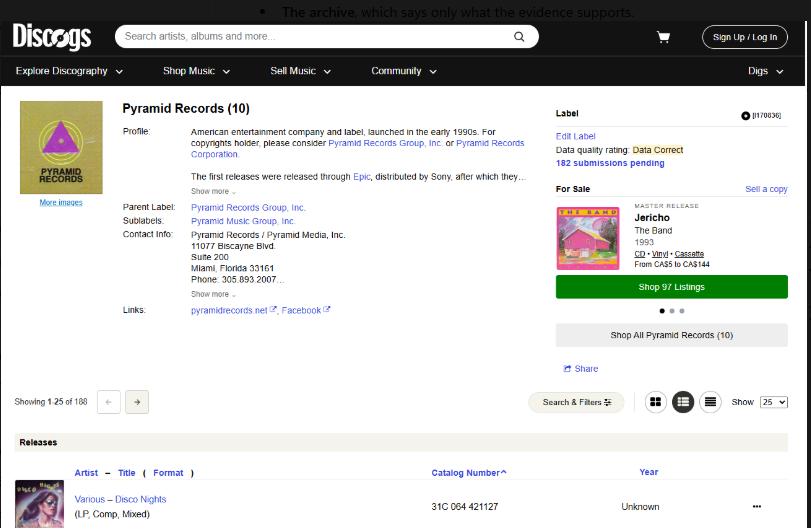
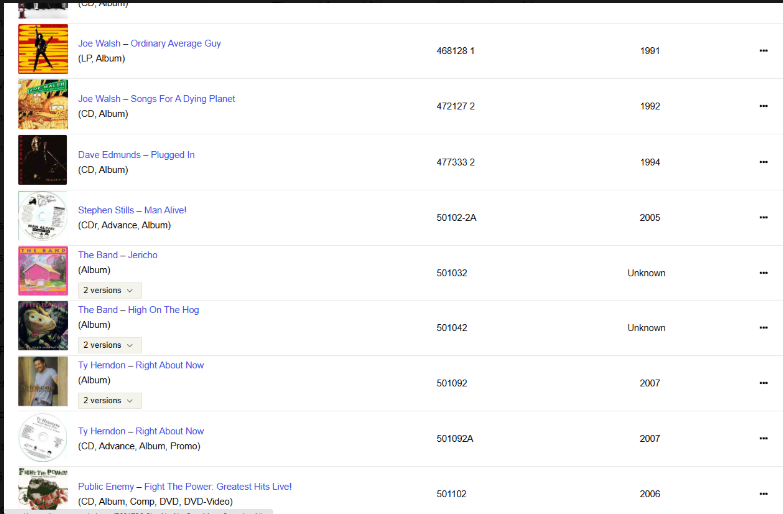
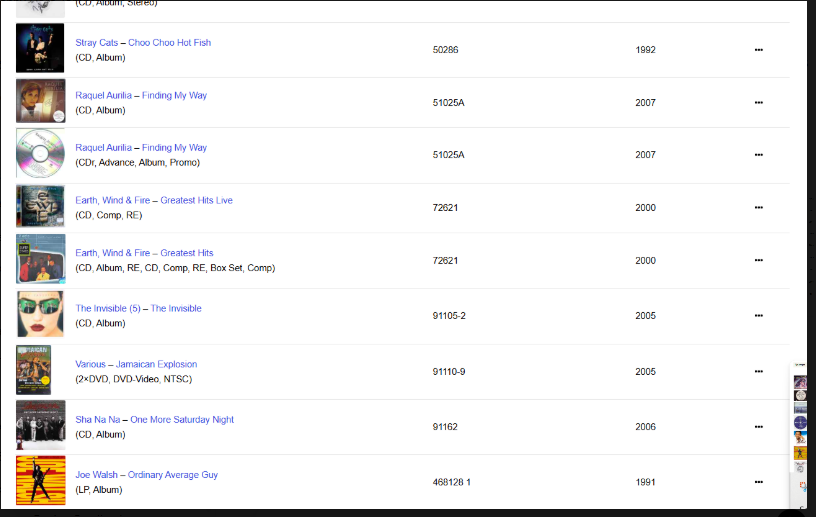
Pyramid first appears in the recovered history as a record-label identity. Its archived account places the beginning around 1990 and connects the label's early story to releases involving Joe Walsh, Asia, The Band, Stray Cats, Dave Edmunds and other established artists.
The first recovered incorporated label entity, Pyramid Records Corporation, was formed in Florida in 1995. It dissolved in 2004, but the Pyramid Records name survived as the label and trade-name identity used by later operating companies.
This distinction matters: the music identity endured while the legal structures underneath it changed.
The Working Partner Group
“Partners” describes the people working together to build Pyramid. It does not mean a legal partnership, equal equity, identical authority, or identical compensation.
2,500,000 shares · 50% reported ownership. The central continuity figure across the label and 2013 issuer.
500,000 shares · 10% reported ownership. Documented New York participation in the issuer.
500,000 service shares. Precise operating mandate remains under continuing research.
800,000 shares · 16% reported ownership. Production, manufacturing and distribution leadership.
250,000 shares · 5% reported ownership. Connected to the planned live-entertainment expansion.
290,000 shares · 5.8% reported ownership. Media and sales experience described by the company.
25,000 service shares. Joined the financial and filing phase during 2013.
Documented Executive Role
Director · Treasurer · New York
The public archive establishes formal participation in the 2013 issuer. Future approved evidence and narration may explain business development, financing, strategy, introductions and operating responsibilities. Those responsibilities are reserved—not inferred.
Two Cities
The recurring operating address across Pyramid Records Corporation, Pyramid Media, the issuer, archived label pages and public catalog references.
Filed participant addresses establish a New York leadership and business presence. The exact operating division between 55 Broad Street and 48 Wall Street remains open.
The Catalog
The owned 2013 master catalog is not the same thing as the wider historic Pyramid release story.
The filing reported approximately $3,000 per month in nominal revenue from this catalog.
Stray CatsChoo Choo Hot Fish
AsiaAqua
The BandJericho
Dave EdmundsPlugged In
The BandHigh on the Hog
Edgar WinterWinter Blues
The BandThe Best of The Band Volume II
A broader release history reconstructed from archived company pages and public catalog evidence. Continuing ownership is not implied.
Distribution Through Time
Company history and release metadata connect the early Joe Walsh era to Epic/Sony. Original agreements remain requested.
Company statementThe archived history associates the Stray Cats and Asia phase with BMG.
Company statementHistoric release relationships requiring agreement-level or release-level confirmation.
Release verificationThe strongest documentary layer: filed manufacturing, distribution, extension and assignment evidence; physical goods distributed through Universal.
Filed agreementArtists and Projects
Preserved in the archived discography and public catalog evidence, subject to release-by-release rights verification.
Cameo and Con Funk Shun were described as signed, with $10,000 advances recorded for each.
Ohio Players, Tony! Toni! Toné!, The Temptations, Stephanie Mills, The O'Jays, The Stylistics, Lenny Williams, Pointer Sisters, Lester Troutman/Zapp and Isley Brothers appeared at different preliminary stages.
The Groove Nation Tour and related media concepts remain planned projects unless future evidence establishes production, performance or revenue.
Corporate Evolution
Florida label corporation. Administratively dissolved in 2004.
Intermediate Florida entity. Later merger documentation remains missing.
The operating music company acquired by the 2013 parent.
Nevada parent and proposed Regulation A issuer.
Supporting Chapter · 2013
Pyramid attempted to finance expansion through a newly formed parent and a proposed Regulation A offering. It was an important chapter—not the beginning of the music business and not the identity of Pyramid.
The record does not call the transaction rejected, completed or publicly traded without a document establishing that result.
Historical Assessment
Pyramid's significance rests in the combination: a durable label identity, a release history involving major artists, an operating catalog, a documented distribution platform, experienced music and media participants, and an effort to build a larger entertainment company.
The record also preserves the limits. Legal succession was complex. Some artist relationships had expired. Several future projects remained preliminary. Public-company expenses rose while the offering moved through regulatory review without reaching a recovered public-market outcome.
The opportunity, the work and the unfinished elements belong together. Pyramid was a real operating music company before it became a proposed securities transaction.
Evidence Drawers
Initial offering statement, four amendments, financial statements, capitalization, biographies and exhibit index.
Open offering statementOpen Amendment No. 4Staff questions show how the issuer was required to clarify identity, current versus planned business, artist rights, distribution claims and accounting.
Open June 2013 comment letterFormation, dissolution and merger-status records for the successive Pyramid entities. Additional merger documentation remains requested.
Native state records reserved for artifact intakeOwned-master disclosure, archived company discography and public catalog captures remain separately classified.
Original sleeves and catalog sheets requestedFontana manufacturing/distribution agreement, extension and assignment evidence. Clean native agreement copies remain requested.
Distribution artifacts reservedPhotographs, business cards, correspondence, contracts, office records, narration and personal artifacts will enter only after provenance and publication review.
No private artifacts published in v0.1Reserved Collections
Connection points are ready. No Collection story has been invented or published.
Meetings and personal context
Office, label and catalog life
Broad Street and Wall Street
Artists, releases and production
Meetings, deals and movement
Living Archive
Continue Through Business Vault