September 2013 Form 10-Q
Documents the predecessor history, Champion acquisition, business plan, financial condition and internal-control disclosures.
Open SEC filingBusiness Vault · Corporate Reconstruction
A public-company record reconstructed from filings, agreements, archived corporate materials, regulatory records, and clearly preserved evidence gaps.
Research Status
The voice behind the record
Benny Doro recalls the formation, financing, governance challenges, and outcome of Champion Pain Care. This first-person account is preserved as oral history and remains distinct from the documentary record.
0:00 / 8:02 Listen while you explore.
This transcript records Benny Doro's recollection. It is not corporate evidence. Statements involving dates, capitalization, financing, individuals, litigation, or corporate actions remain subject to the evidence classifications used throughout this record. The transcript was lightly edited for readability; the original recording is authoritative.
Champion Pain Care. CPAI. It is 2013, and I have decided to take a little break from New York and come up to Canada to relax and recover from some health issues that really just needed rest. I thought: what a great place. It is laid back, I know it well, and there are some cool people around. What a mistake.
A friend of mine, Greg Worobek, who had come to New York and stayed at my place for a while, said, “Listen, these guys want to go public. They are called Champion Pain Care. They do organic pain management.” I said okay. We had special-purpose acquisition companies ready for a deal. They were essentially blank public vehicles into which a company could be placed, with the particulars and name changed, a symbol obtained, and the required market documentation filed.
I thought we would do our normal deal: some upfront fees and part of the stock—usually not much, perhaps two or three percent. We would help get them to the public-company stage, do some marketing, explain how it worked, and set them up with the right counsel and accounting.
I met the group: Dr. Terry Brown, a man named Jason, another person whose role I was not sure about, and Greg heading the effort. We decided to put the deal together. We completed the preliminary exchange agreement, and everyone wanted to come to New York, meet Charlie, and learn about Wall Street. They flew down, visited the Stock Exchange, and Charlie explained how things worked.
We got the symbol CPAI. I recall that approximately one hundred million shares were initially issued, but that must be checked against the filings. I recall the company opening at approximately a $55 million market capitalization even though the operating business was still at an early stage. The public structure was intended to help obtain financing, enter the United States, and acquire a clinic that could be converted to the new pain-management model.
I had seen white papers for the approach, although I did not fully understand the clinical side. Financing of approximately $7 million was arranged. My view was that the proceeds should acquire one or perhaps two clinics, fund their conversion, and retain a substantial cash reserve. It was convertible financing with a significant monthly interest burden. If it was not repaid and converted into stock, the lender could receive a substantial position in the company.
The stock began trading. Then an announcement appeared saying that a clinic had been acquired using the financing proceeds. Charlie and I had not been told in advance. We were concerned that putting all of the proceeds into one clinic was not the best use of funds, but management believed in the clinic, its revenue, and its ability to service the interest payments.
Charlie had serious concerns. This connects to the collection story, “The Coffee Was the First Red Flag.” As time passed, we asked for the clinic's financial statements and operating information. We then learned of problems associated with a doctor and prior misconduct issues. In my recollection, the licensing transfer was not progressing and the clinic had become a white elephant, leaving the company without the anticipated revenue base while interest obligations continued.
I spoke with the lenders. They were willing to consider a solution because nobody benefits from immediately shutting a company down and taking whatever remains. We discussed finding another transaction or issuing additional shares. Management did not want to pursue our proposed approach and had its own plan. It was their company, but we had stock and our people involved, so we had skin in the game.
Management eventually completed a transaction with another person who promised to save the company. A very large number of shares was issued; the filings should be consulted for the exact amount. I do not clearly recall the person's name. He became the new chief executive. In my recollection, the promised restructuring did not materialize. The lenders then converted their position, and that effectively ended Champion Pain Care as an operating company and publicly traded venture.
The matter did not end there. The lenders wanted recovery and pursued litigation involving company directors. I acted as a point person with Bank of America, where the accounts were held. The lenders pursued additional avenues against directors, but time passed and the situation eventually cleared.
I believe the lender itself was later disbanded. What remained was a story with considerable damage on all sides and lessons worth preserving. We had also waived fees we would normally have charged because Greg was a friend and we believed the participants would do the right thing. It was a lesson, and hopefully the record gives others a useful warning. That is Champion Pain Care.
Thirty-second briefing
Executive Summary
Champion Pain Care Corp. was built around an ambitious proposition: combine a licensed pain-management protocol with a network of clinics developed through licensing, joint ventures, and acquisitions. The company entered the public markets in 2013 through a share exchange with OICCO Acquisition I, Inc., an existing Delaware blank-check issuer whose previous automotive transaction had been substantially unwound.
The exchange changed both the ownership and purpose of the public company. OICCO issued 31.5 million shares for the Champion business, giving the incoming Champion group majority ownership and board representation. The company later adopted the Champion Pain Care name and ticker CPAI.
Champion expanded management, used equity and consulting arrangements, and obtained secured financing intended to support clinic acquisitions and working capital. The financing also introduced conversion, voting, board, collateral, and pledge rights. After TCA alleged default, receiver reports stated that the lender acquired majority control in July 2017.
Champion's periodic reporting ended after the quarter ended September 30, 2016. The SEC revoked the registration of its securities effective February 8, 2023.
The Public Vehicle
OICCO Acquisition I, Inc. was incorporated in Delaware on July 24, 2009 as a blank-check and development-stage company. It was formed to identify and complete a merger or acquisition rather than operate a mature business of its own.
That structure offered a private company a route into the public markets without a conventional initial public offering. The public vehicle supplied the corporate and reporting framework; the incoming company supplied the business, management, and strategy.
OICCO's earlier Imperial Automotive transaction was substantially unwound in July 2013. Forty million OICCO shares were returned after management concluded that the proposed expansion was not viable and that the subsidiary had minimal assets. The complete legal disposition remains unresolved, but the filing establishes that Imperial did not become OICCO's lasting operating identity.
Documents the predecessor history, Champion acquisition, business plan, financial condition and internal-control disclosures.
Open SEC filingPublic Market Debut
Champion Pain Care entered the public markets through its reverse-merger transaction and began trading in July 2014. The first recovered market quotation records a share price of $0.50.
Sparse observations recovered from a secondary historical-price table. The ticker was later reused by an unrelated security; only pre-reuse Champion observations are shown.
First recovered observation after the SEC-reported trading commencement. At 45 million reported shares, the implied capitalization was $22.5 million.
Highest recovered observation in this data set. At 45 million reported shares, the implied capitalization was $45 million. Reported volume was only 220 shares.
By June 2015, filings reported 119,438,500 shares issued and outstanding after the authorized ceiling increased to 500 million shares.
The filings establish the trading date and reported capitalization. The secondary table supplies sparse price observations. Authorized shares describe the corporate ceiling; conventional market capitalization uses issued-and-outstanding shares. The recalled $55 million valuation will not be presented as a verified headline unless a contemporaneous supporting document is recovered.
What Champion Intended to Build
The company described a strategy extending beyond a single practice: license the protocol, form joint ventures, and acquire pain clinics and related medical operations.
On February 1, 2013, Champion Care Corp. of Ontario granted the Nevada Champion entity exclusive United States rights to the Champion Pain Care Protocol, with automatic five-year renewals and a 10% net-sales royalty.
Management described approximately 1,500 identified practices, four acquisition agreements, and additional transactions in progress. These were issuer statements, not proof that the proposed transactions closed.
Protocol rights, management services, and operating responsibilities moved across Canadian, Nevada, and public-company entities.
Public Company Evolution
During 2014, the company announced DTC eligibility and trading under OCAQ. A DTCC notice recorded the deletion of OCAQ/OICCO Acquisition I and addition of CPAI/Champion Pain Care Corporation effective October 31, 2014.
The new identity aligned the public vehicle with its operating plan. At the same time, the first Champion-era quarterly filing reported no revenue, going-concern uncertainty, and material weaknesses involving staffing, segregation of duties, accounting policies, computer security, disaster recovery, and whistleblower procedures.
Those disclosures do not establish misconduct. They show a company attempting a complex public-company expansion while still developing the financial and administrative systems required to support it.
Organization and Capital
Champion used management services, executive agreements, consultants, and equity incentives to build the organization.
Filed agreements documented management, marketing, training, and business-development support. Complete payment and share-conversion history remains outstanding.
A May 2015 agreement issued 4.5 million shares and contemplated another 8 million shares upon specified outcomes. The contingent issuance remains unresolved.
Garland Brown became CEO, Mark Conner was engaged as COO, and Jack Fishman continued as president. Terrance Owen was later appointed CFO.
The 31.5 million-share exchange block moved through corporate and individual holders. Later filings recorded service shares, creditor transfers, gifts, consulting positions, and new executive holdings at different dates and denominators.
Financing the Clinic Strategy
In December 2016, Champion entered a secured revolving financing arrangement with TCA Global Credit Master Fund and announced two Florida clinic acquisitions.
These figures measure different parts and stages of the transaction. They are not interchangeable.
Assets and pledged securities supported the lender obligations.
Conversion rights operated subject to a stated beneficial-ownership limitation unless waived.
One super-voting share carried specified veto powers and the right to elect, remove, or fill one board seat.
Control Timeline
Use Enter or Space to open an event. Arrow keys move between events.
The share exchange gave the incoming Champion group majority ownership and board representation.
Champion Care management services, individual ownership changes, consulting equity, and expanded executive appointments created additional authority and compensation layers.
The TCA package added conversion rights, collateral, pledged shares, voting power, veto rights, and a designated board seat.
TCA alleged an uncured non-payment default and demanded pledged securities and transfer documents.
Receiver reports later stated that TCA acquired majority control through enforcement of the share pledge.
Benny Doro's Connection
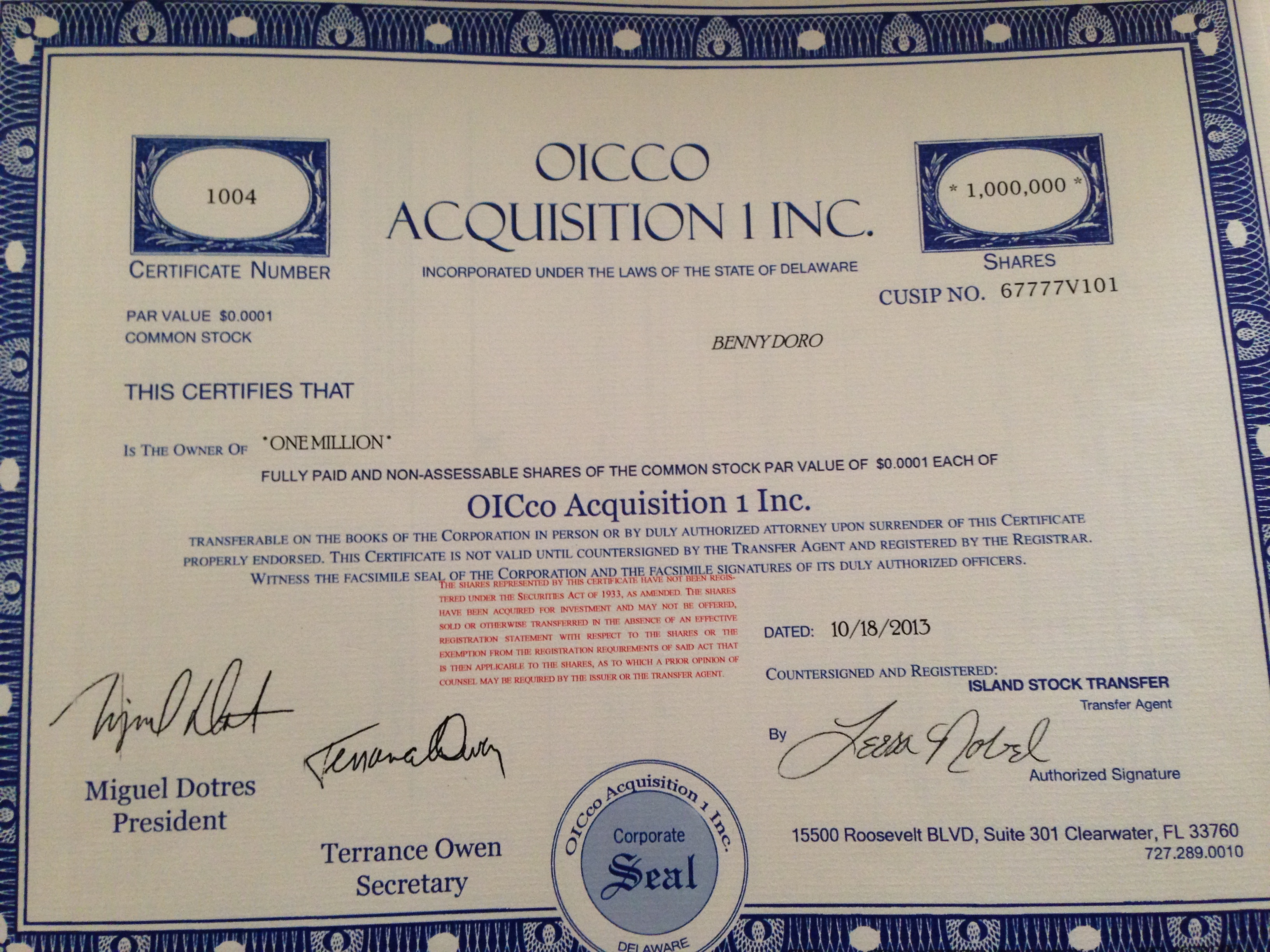
Stock certificate no. 1004, dated October 18, 2013, identifies Benny Doro as the registered owner of 1,000,000 common shares of OICCO Acquisition 1 Inc.
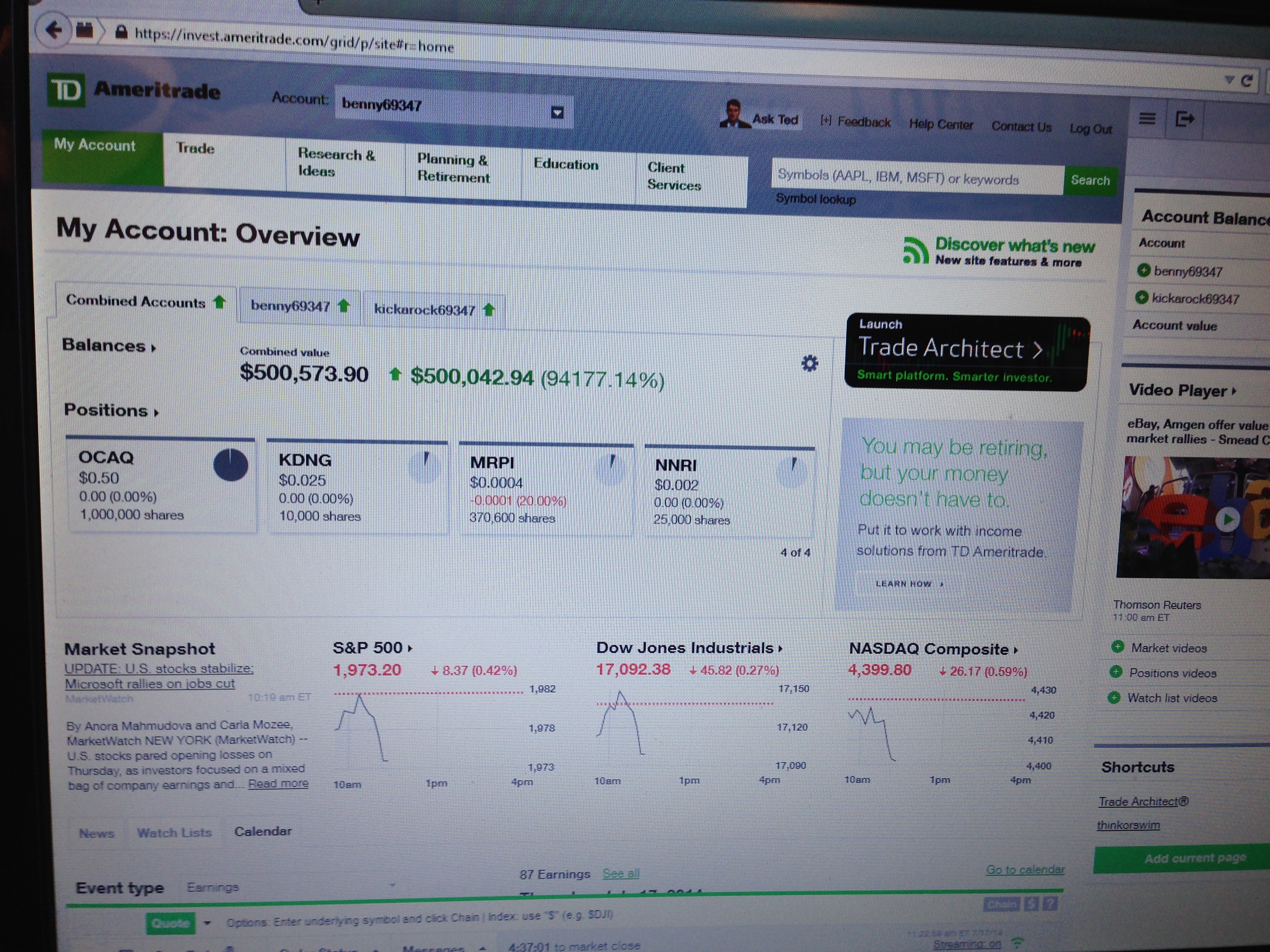
A separate TD Ameritrade account image shows 1,000,000 OCAQ shares at a displayed quote of $0.50. Together, the artifacts establish registered ownership and later brokerage custody under the public ticker. They do not, by themselves, document the later OCAQ-to-CPAI book-entry conversion or subsequent trades.
No recovered public filing, agreement, archived management page, announcement, signature page, or receiver record identifies Benny as an officer, director, consultant, creditor, signatory, or employee.
His recollection of direct involvement and a possible directorship remains a research lead, not a dated corporate fact.
The share-exchange agreement lists Suite 1518, 1030 West Georgia Street, Vancouver as a Champion notice address. The evidence does not establish Champion's daily occupancy, Benny's use or control of the suite, or a shared-office arrangement involving a Benny company.
Private Evidence · Revision 2
Two authentic artifacts now establish the opening ownership trail. Both are displayed exactly as originally supplied; no content has been recreated or replaced. The remaining steps are preserved separately as firsthand recollection until brokerage statements, trade confirmations, or transfer-agent records are recovered.
Reserved Module
No first-person reflection has been approved. This space will be populated only from Benny Doro's reviewed narration or approved executive copy.
Awaiting approved source materialGovernance and Corporate Events
The documentary record shows a company attempting to build an operating platform while its financing, management, and control arrangements became increasingly complex.
The evidence supports factual discussion of disclosed control weaknesses, layered service agreements, equity compensation, preferred voting rights, pledged shares, default, and lender control. It does not support personal blame or a conclusion about who proposed or opposed the TCA transaction, what alternatives were considered, or whether conflicts were disclosed and managed.
TCA's notice and receiver materials document the default allegation, enforcement proceedings, and reported acquisition of majority control. Allegations remain allegations except where the recovered record identifies a judgment, settlement, dismissal, or completed control event.
Xnergy Financial also filed a contract action in 2017. Revision 1 contains a public case index but not the complaint or final disposition.
Outcome
Champion's public reporting stopped after the quarter ended September 30, 2016. The company did not answer the SEC's later administrative proceeding or show-cause order. The SEC revoked the registration of its securities effective February 8, 2023.
Revocation closed the federal reporting chapter, but it does not answer every operational question. Revision 1 does not establish precisely when clinical operations ceased, what happened to each clinic, how protocol rights were finally disposed of, or when every related corporate entity stopped operating.
The defensible documented sequence is narrower: the expansion strategy was followed by secured-lender enforcement, reported transfer of majority control, reporting delinquency, and eventual revocation of the public securities registration.
Historical Assessment
Champion pursued a recognizable opportunity: bring a pain-management protocol into a larger clinic network and use a public-company structure to support expansion.
The company developed management relationships, recruited executives, obtained public-market visibility, secured acquisition financing, and announced two clinic transactions.
It began the Champion phase with limited financial and administrative infrastructure while its capitalization and authority arrangements became layered.
Financing protections became instruments of enforcement and reported control transfer after an alleged default.
The documents show opportunity, execution attempts, financing constraints, governance complexity, and eventual loss of control. They do not yet reveal every private decision or personal responsibility behind those events.
Evidence Archive
Every exhibit retains its source type and evidence classification. Source links remain visible even when drawers are closed.
Documents OICCO predecessor history, Champion acquisition, business plan, financial condition, and internal-control disclosures.
Establishes transaction form, exchange structure, board transition, and the existence of omitted shareholder schedules.
Establishes the licensed United States protocol rights, renewal terms, and royalty structure.
Establishes the effective public identity transition on October 31, 2014.
Shows how management publicly described clinic MOUs, prospects, market status, and strategy.
Preserves the company's own presentation of its operating model.
Preserves how the company publicly identified its leadership in May 2015.
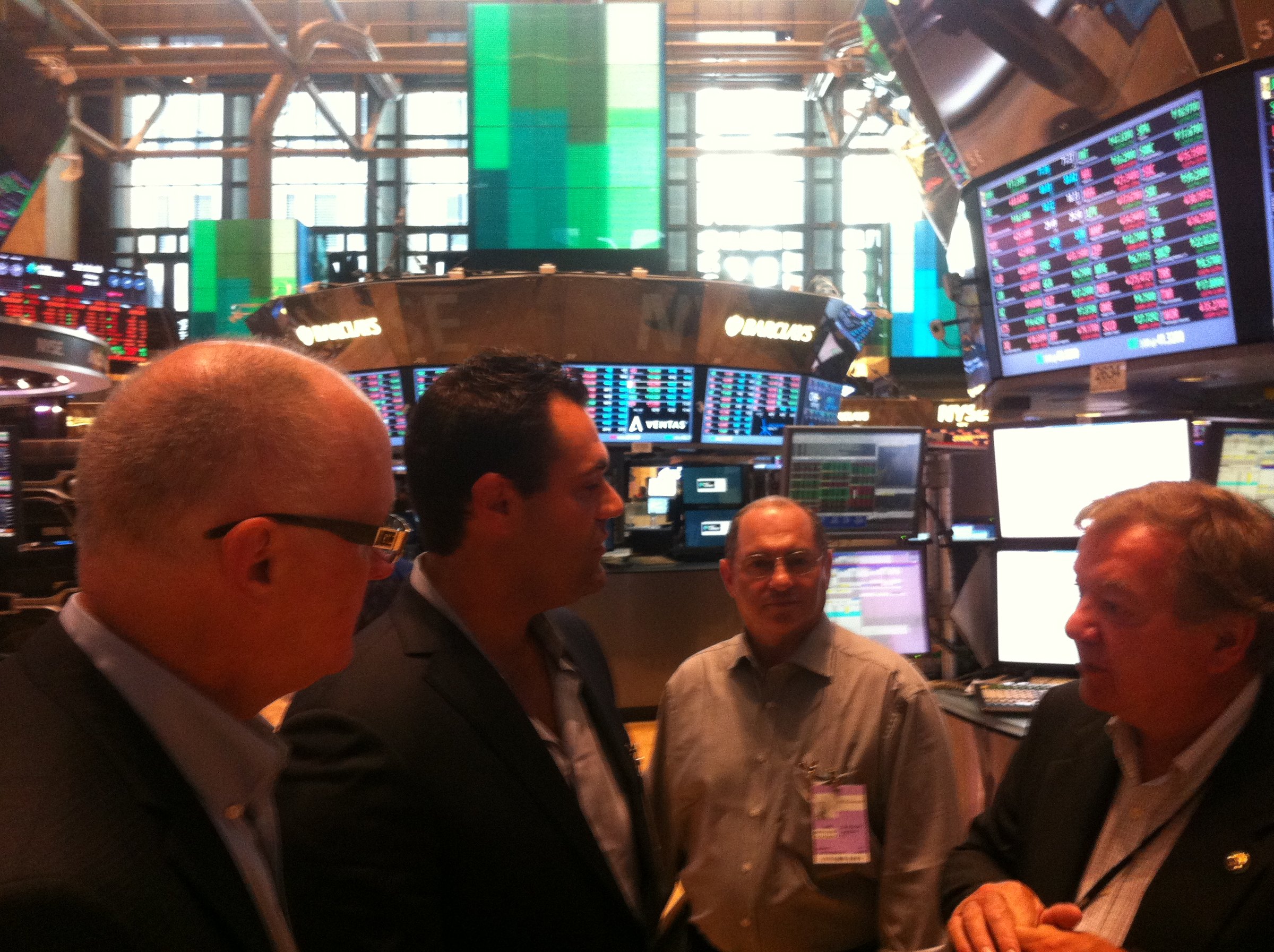
One image from a 13-photograph set dated July 19, 2013. The photographs document the Champion Pain Care party's presence at the New York Stock Exchange. They do not independently establish transaction terms, financing, corporate authority, or legal roles.
Documents consulting scope, the 4.5 million-share issuance, and contingent equity terms.
Documents the voting, veto, and board-seat rights within the lender package.
Records TCA's allegation of uncured non-payment and demand for pledged securities.
Reports litigation history, the stated demand, and TCA's acquisition of majority control.
Establishes revocation of the registration of Champion's securities.
Certificate no. 1004 identifies Benny Doro as the registered owner of 1,000,000 common shares of OICCO Acquisition 1 Inc., dated October 18, 2013, under CUSIP 67777V101 and countersigned by Island Stock Transfer.
A TD Ameritrade account image shows an OCAQ position of 1,000,000 shares at a displayed quote of $0.50. The capture date is not independently established, and the image does not document later conversion or disposition.
Reserved for approved emails, board records, capitalization, transfer-agent material, office evidence, agreements, photographs, and communications.
Research Continuing
They are not concealed, simplified, or filled by inference.
Which brokerage statements, trade confirmations, or transfer-agent records document the OCAQ-to-CPAI conversion, later sales, use of proceeds, retained balance, and Charlie's beneficial interest?
Did Benny serve in a formal or informal capacity, and what authority, responsibilities, and compensation defined it?
What do the omitted exchange schedules and Champion Care securities register disclose?
What were the legal names, closing records, operating results, and final disposition of the Florida clinics?
What do board records show about financing, clinic purchases, management changes, and control transfer?
What were the complete outcomes of the TCA and Xnergy matters?
The share certificate and brokerage image now establish the opening ownership trail. The page retains insertion points for authority, office, later capitalization, transfer-agent, brokerage, clinic, governance, litigation, communication, email, photograph, and press-release evidence.